
Lesson 1 – The Basics
Basics for How to…
The Basics section will provide information on how to use components and other resources common to several projects. It will provide a starting point to learn about certain topics before jumping to implementation to solve a Wildlife Challenge.
How does an Ultrasonic sensor Work?
The ultrasonic sensor uses sonar to determine the distance to an object. Here’s what happens:
- the transmitter (trig pin) sends a signal: a high-frequency sound
- when the signal finds an object, it is reflected and
- the transmitter (echo pin) receives it.
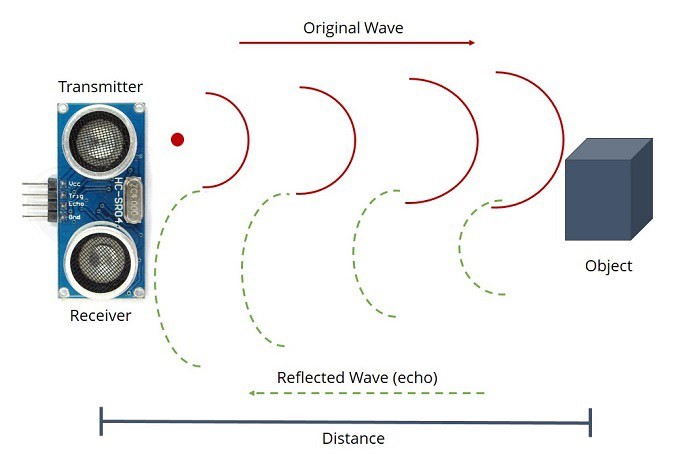
The time between the transmission and reception of the signal allows us to know the distance to an object. This is possible because we know the sound’s velocity in the air.
How to use a breadboard?
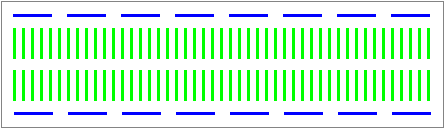
Breadboards consist of tiny “holes” in which the leads of the component connect into. Make sure that if you are using wire, use wire links, not the stranded wire, because it will crumple in the holes and damage your breadboard.
The top and bottom rows (the rows indicated by the blue) and are usually the (+) and (-) power supply holes and these move horizontally across the breadboard, while the holes for the components move vertically Each hole is connected to the many metal strips that are running underneath.
Each wire forms a node. A node is a point in a circuit where two components are connected. Connections between different components are formed by putting their legs in a common node. On the bread board, a node is the row of holes that are connected by the strip of metal underneath.
The long top and bottom row of holes are usually used for power supply connections.